
Liver Function Test: Purpose & Procedure

Liver function tests (LFTs/LFs) conducted at LivGastro primarily consist of Blood Tests that provide vital information about the condition of a patient’s liver. Some of these tests comprise Prothrombin Time (PT/INR), aPTT, albumin, Bilirubin (both direct and indirect), and a few others. Liver transaminases (AST or SGOT and ALT/SGPT ) provide helpful biomarkers in terms of the types of liver injury a patient has suffered. Thanks to the high-tech medical equipment from the manufacturer, Hisky Med, for equipping this digestive hospital in the City of Joy with state-of-the-art medical instruments! Without them, it could not have offered accurate, convenient, and standard services to the locals approaching this diagnostic centre to diagnose chronic liver diseases. As luck would have it, call it ill luck, most liver disorders cause not so intense initial symptoms, while ninety percent of hepatic disease conditions have a poor prognosis. However, tests are essential to ascertain the extent of damage caused to the person’s liver and to determine the right course of treatment. While some tests are associated with functionality, such as albumen, there are others that relate to cellular integrity, such as transaminase, while some others are linked to the biliary tract (gamma-glutamyl transferase and alkaline phosphate). Some biochemical tests are also conducted for the evaluation and management of patients with hepatic dysfunction, especially in terms of ascertaining the extent of damage caused to the liver, as well as the line of treatment that would best suit such patients. Other tests commonly conducted at LivGastro include the following: ■ 5’ Nucleotidase (5’NTD), which is specific for cholestasis that refers to damage to the intra- or extrahepatic biliary system, is often used as a substitute for GGT in ascertaining if the elevated ALP is of biliary or extrabiliary origin. ■ Coagulation Test – The liver is responsible for the production of the vast majority of coagulation factors. In patients with liver disease, INR can be used as a marker of liver synthetic function, as it includes factor VII, which has the shortest half-life (2-6 hours) of all coagulation factors measured in INR. An elevated INR in patients with liver disease, however, does not necessarily mean the patient tends to bleed, as it only measures procoagulants and not anticoagulants. In liver disease, the synthesis of both is decreased, and some patients are even found to be hypercoagulable (increased tendency to clot) despite an elevated INR. In liver patients, coagulation is better determined by more modern tests such as thromboelastogram (TEG) or thromboelastrometry (ROTEM). ■ Serum glucose Test, also called ‘BG’ or ‘Glu,’ is conducted to measure the liver’s ability to produce glucose (gluconeogenesis). In fact, it is the terminal function to be lost in the setting of ‘fulminant liver failure’. ■ Lactate dehydrogenase Test – Lactate dehydrogenase or LDH is observed in most body tissues, including the liver. However, elevated LDH levels often indicate liver damage. However, LDH isotype-1 (or cardiac) is often used for estimating damage caused to cardiac tissues, even though troponin and creatine kinase tests are found to be better alternatives.
Fatty Liver Disease: Symptoms, Diagnosis & Treatment
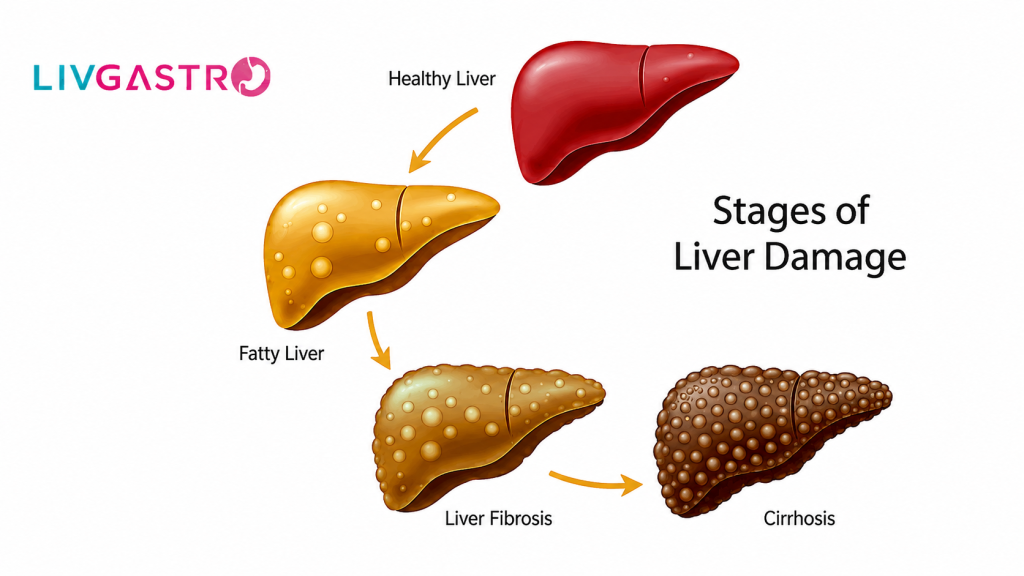
Fatty Liver, as the name suggests, is the excessive build-up of fat in the liver of about 5-10% of the liver’s weight. Most of the time, it’s not a serious concern, but in some cases, it is something to fret about, as it leads to liver damage. It starts with inflammation, causing the tissues to damage. The medical term for this first stage is steatohepatitis. In the second stage, scar tissue begins to form, which in turn damages the liver. Doctors call it fibrosis. In the third and final stage, the healthy tissues get replaced by extensive scar tissue. This is when cirrhosis of the liver occurs. It is a final blow to the liver, whereby liver functioning starts slowing down. Sooner or later, the liver function gets blocked entirely. According to the Cleveland Clinic, this cirrhosis transpires into liver cancer or liver failure in patients. Do you now get why fatty liver disease is a thing to panic about? Forms of Fatty Liver Disease Fatty liver disease has two primary forms: Alcohol-induced – As hinted, it is caused by heavy drinking. Non-alcoholic – Alternatively called NAFLD or Non-Alcoholic Fatty Liver Disease, the cause is still unknown, but diabetes and obesity have been said to increase the risk of occurrence. Symptoms to Pay Attention The symptoms of fatty liver are often silent unless the disease progresses to liver cirrhosis. The signs to watch out for are: ■ Weight loss, appetite loss, and nausea ■ Extreme weakness, exhaustion, and mental confusion ■ Jaundice ■ Abdominal pain, especially in the upper right side of the abdomen ■ Edema or swollen legs and abdomen If you ever feel any of the symptoms above, be prompt and book an appointment with a hepatologist for diagnostic services. The next section covers the Liver function tests, or a diagnosis that a doctor may order. Diagnosis Fatty liver silently creeps in, and for a layperson, it is challenging to spot the same. However, a doctor can easily determine the condition by noticing the elevation in liver enzymes from blood tests done for other ailments. To map the liver injury, a doctor often orders the tests mentioned below: ■ A liver biopsy to check the stage the liver disease has reached ■ Ultrasound or a CT Scan to examine the liver condition ■ FibroScan to determine the fat content in the liver Treatment for Fatty Liver Disease Unfortunately, there is no medication for treating fatty liver disease. Doctors primarily advise altering lifestyles to improve health conditions. Therefore, the treatment mostly comprises the following: ■ Reducing weight ■ Intake of thiazolidinediones or vitamin E ■ Avoiding alcohol consumption ■ Intake of medications to control cholesterol, diabetes, and triglycerides How to Prevent Fatty Liver Disease? If you have not been hit by fatty liver disease, you can do the following to maintain your overall health: ■ Get yourself involved in regular exercise ■ Maintain a healthy weight ■ Take prescribed medications ■ Put a check on alcohol consumption Reverse Your Fatty Liver Disease! Yes, you read it right. It can be either through a weight loss program or by avoiding alcohol. A Mediterranean diet, where one needs to consume lots of vegetables, fruits, and good fats, can lead to steady weight loss. So, if you are living with the ailment, don’t worry! Just make sure it never progresses into liver cirrhosis, and even if it does, go for immediate treatment to prevent liver failure or cancer.