
Irritable Bowel Syndrome: Symptoms, Causes & Treatment

patient with digestive health concerns

What is Irritable Bowel Syndrome (IBS)?  Irritable Bowel Syndrome (IBS) is a fairly common bowel-related disorder that is linked to the colon or the large intestine. However, contemporary researchers hint at abnormalities in the brain/gut connection that are likely to trigger IBS. Be that as it may, IBS causes irritability and uneasiness associated with bloating, gas, cramping, diarrhea or constipation, and above all, an abrupt and untimely urge to defecate, forcing the affected person to visit the nearest toilet post-haste. This often puts the person in an disagreeable position, especially if he/she is taking part in a conference or addressing a meeting. With most people (more with women), it is a chronic condition that takes time to manage appropriately.  What are the symptoms of IBS?  Even though IBS symptoms vary from person to person and from stage to stage, some of the common symptoms are outlined below.  ■ Abdominal pain and/or cramping  ■ Bloated feeling  ■ Too much stomach gas  ■ Diarrhea or constipation – oftentimes alternating episodes of constipation and diarrhea  ■ Mucus in stool  ■ Erratic and unpredictable pattern of bowel movement  What causes IBS?  As earlier mentioned, abnormalities or more suitably said, dysfunction in the connection between the brain (command center for the nervous system) and the gut (gastrointestinal tract) seemingly contribute towards the onset of IBS in human beings. Also, there is a close two-way link between the brain and the gut, while intricate pathways link the brain and the intestines with information coming and going continuously. Mortal fear often triggers diarrhea in otherwise healthy people. No wonder researchers have found evidence that dysfunction along these corridors is contributing to abdominal pain, gas, and diarrhea, which are primary symptoms of IBS.  At the same time, nerves in the gut that have experienced too much sensitivity can also trigger changes in the thalamus. Thoughts, feelings, and activation of parts of the brain that tackle anxiety or worries can stimulate exaggerated gut responses. To be precise, the dysfunction in the brain-gut communication system verily interferes with the body’s ability to remain in a normal situation when all systems are working well.  As for the colon-related issue, we know that the muscles in the colon work ceaselessly to push away the body’s waste products by continuously contracting and relaxing. However, these muscles also need to work in unison with other muscles to complete the job. But when that unison or harmony is broken or disrupted, the contents of the colon get stuck, giving rise to cramps, gas, bloating, constipation, and in extreme cases, diarrhea.  Irritable Bowel Syndrome may also be triggered through:  ■ Foods – Although the role of food allergy or intolerance in irritable bowel syndrome has not been clearly established, studies reveal that many people present more severe symptoms when they eat certain foods. A wide range of foods has been mentioned that include chocolates, spices, fats, fruits, beans, cabbage, cauliflower, broccoli, milk, carbonated beverages, and alcohol.  ■ Stress – Quite a lot of people with IBS find that their signs and symptoms are worse or more frequent during periods of increased stress, such as finals week or the first weeks on a new job. But while stress may exacerbate the symptoms, it doesn’t cause them. ■ Hormones – Since women are twice as likely to have IBS, it is generally believed that hormonal changes play a role in this condition. Many women find that signs and symptoms are worse during or around their menstrual periods.  Treatment modes for IBS  To be honest about it, there is no cure for Irritable Bowel syndrome, but you can manage the symptoms fairly well if you pay attention to the issues outlined below. ■ Cut down consumption of caffeine and alcohol  ■ Reduce consumption of fried foods/ fatty foods  ■ If diarrhea features as a general symptom, limit dairy products  ■ Enhance fiber content in food to help relieve constipation  ■ Stay away from cabbage, cauliflower, broccoli, and beans, to help relieve excessive stomach gas/bloating  Postscript:  Don’t get disheartened, IBS is not a life-threatening disease condition. Neither is extremely painful. However, the only way to conquer IBS would be to conquer yourself. Observe minutely what food disagrees with you; whether changing lifestyle helps lessen symptoms. Also, consider consultation with a therapist to reduce stress if you are unable to do it yourself.  

Capsule Endoscopy: What Gastroenterologists Want You to Know
gut health

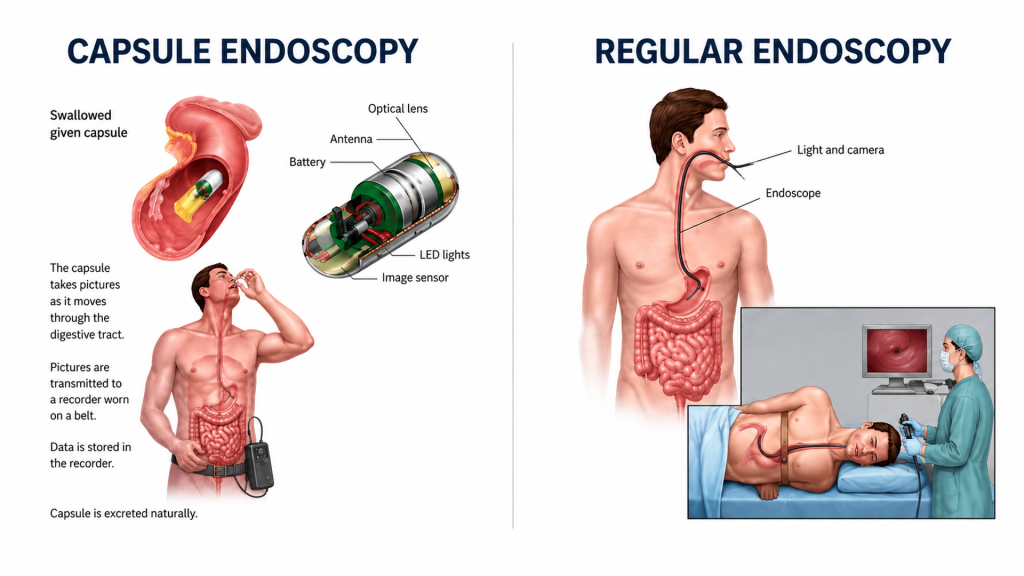
You have probably had a colonoscopy recommended, or perhaps an upper endoscopy. What about the stretch of digestive tract in between – the small intestine – that stretches nearly six metres and sits largely out of reach of conventional scopes? That’s where capsule endoscopy comes in.  If you have been dealing with persistent abdominal pain, unexplained bleeding, or recurring digestive discomfort and have not found answers yet, consulting the best gastroenterologist you can find might lead you straight to this procedure. It’s less intimidating than it sounds, and it often reveals what everything else misses.  What is Capsule Endoscopy and How Does It Work? Capsule endoscopy is a diagnostic procedure in which you swallow a small capsule — roughly the size of a large vitamin tablet — containing a tiny camera, a light source, and a radio transmitter. Once swallowed, the capsule travels naturally through your digestive tract, from the oesophagus down to the small intestine, capturing around 10,000 photographs along the way. These images are transmitted wirelessly to a small receiver worn around your waist. The whole process takes about eight hours, after which the capsule passes out of your body through stool.  Before the procedure, your doctor will administer laxatives to clear the digestive system of food debris. So the camera can capture clear images. There’s no sedation involved. You simply swallow the capsule and go about your day as usual while it does its work inside.  What Conditions Can Capsule Endoscopy Detect? This is where capsule endoscopy earns its reputation. It’s particularly effective at identifying problems in the small intestine that standard endoscopy and colonoscopy cannot reach. Conditions it can help diagnose include:  ■ Unexplained gastrointestinal bleeding — when upper endoscopy and colonoscopy have drawn a blank ■ Crohn’s disease — especially early-stage or small bowel involvement ■ Intestinal tumours — both benign and malignant growths  ■ Angiodysplasias — abnormal blood vessels in the gut wall  ■ Celiac disease — where damage to the small intestinal lining needs to be assessed  ■ Colon polyps and inflammatory bowel disease (IBD)  Symptoms that might prompt a referral to the best gastroenterologist for this test include abdominal cramping, blood in the stool, persistent diarrhoea, chronic fatigue linked to unexplained anaemia, or significant unintended weight loss.  Who is Capsule Endoscopy For?  Capsule endoscopy is recommended for a fairly specific group of patients — those for whom conventional diagnostic methods have been inconclusive or insufficient.  ■ People who have been bleeding somewhere in the gut, and other tests have come up empty  ■ Those with suspected or confirmed Crohn’s disease, where the small bowel needs a proper look  ■ Anyone dealing with ongoing abdominal pain or weight loss that has not been explained yet  ■ Patients keeping an eye on existing polyps or intestinal growths  ■ Those with persistent diarrhoea or signs that the body isn’t absorbing nutrients the way it should — celiac disease being a common culprit  One thing worth knowing: if you have a history of narrowing or blockages in the intestine, your doctor will want to discuss this before proceeding. There’s a small chance the capsule could get lodged, so your gastroenterologist will review your history and decide whether the procedure is right for you.  How is Capsule Endoscopy Different from a Regular Endoscopy?  The most obvious difference is comfort. There’s no scope insertion, no sedation, and no recovery time needed afterwards. You swallow a pill and carry on. That said, capsule endoscopy does have limitations worth understanding: The capsule cannot perform therapeutic interventions — it cannot take biopsies or remove polyps If the capsule moves too quickly, images may be blurred or incomplete If battery life runs out before the capsule completes its journey, areas may be missed Pinpointing the exact location of an abnormality can sometimes be difficult  These are procedural realities, not reasons to avoid it. In many cases, capsule endoscopy remains the most practical and informative way to evaluate the small bowel — and that makes it invaluable.  Book Your Capsule Endoscopy at LivGastro — Kolkata’s Trusted Gastroenterology Hospital At LivGastro, every capsule endoscopy is overseen by Dr. Vijay Kumar Rai — a gastroenterologist recognised by both the American College of Gastroenterology and the American Society of GI Endoscopy.  That’s not just a line on a CV — it means the person overseeing your diagnosis is trained to international standards. We use equipment sourced from Germany, Japan, and America, and every test is carried out by qualified doctors, not left to junior staff.  If you’ve been looking up “acidity doctor near me” or trying to find a gastroenterology hospital in Kolkata where you can actually trust who’s doing your tests, LivGastro is worth a visit. All diagnostic procedures at LivGastro are conducted by highly trained doctors under Dr. Rai’s supervision, and results are delivered promptly so your care can move forward without delay. We provide complete day care gastro and liver services — consultation, diagnostics, pharmacy, and nutrition — all under one roof.  Reach us at +91 9147105221 or WhatsApp 9369120028 to book your appointment. We are available Monday to Saturday, 8 am to 10 pm. 

Prevention of Colorectal Cancer Through Early Detection

Doctor explaining the major risk factors and prevention methods for colorectal cancer to a patient.

What Are The Major Risk Factors?  Some of the key risk factors that cause colorectal cancer include family history (of the disease) as well as old age, while obesity, excessive alcohol use, indolence and cigarette smoking are not ignored either. Alongside, people with a history of inflammatory bowel disease, such as ulcerative colitis and Crohn’s disease, reportedly run a higher risk of having colorectal cancer than those without such conditions.  Screening tests for early diagnosis of colorectal cancer often prevent the spread of cancer. Quite a few screening tests have since been developed to help gastroenterologists such as Dr. V.K. Rai, M.D., and others detect colorectal cancer early, when the disease becomes more treatable. What’s more, some tests that detect or identify the adenomas are known to prevent the development of cancer through proper medical intervention. So, the screening procedure may also be considered as a form of cancer prevention method in most cases.  What Tests Are Recommended For Diagnosing Colorectal Cancer? The following tests and/or investigative procedures are recommended for diagnosing colorectal cancer.  High-sensitivity Fecal Occult Blood Test (FOBT) – Both polyps and colorectal cancers can bleed, while FOBT checks for tiny amounts of blood in feces (stool) that cannot be seen visually. (Blood in stool may also indicate the presence of conditions that are not cancerous, such as hemorrhoids.  As of now, two types of FOBT are approved by the FDA for screening colorectal cancer: guaiac FOBT (gFOBT) and the fecal immunochemical (or immunohistochemical) test (FIT or iFOBT). With both types of FOBT, stool samples collected by the patient with the help of a kit are sent to the gastroenterologist.  ■ Guaiac FOBT uses a chemical to detect heme, a component of the blood protein hemoglobin. Since the guaiac FOBT can also detect heme in some foods (for example, red meat), people have to avoid certain foods before having this test.  ■ FIT uses antibodies to detect human hemoglobin protein specifically (4, 5). Dietary restrictions are usually not applicable in FIT. Studies, however, have revealed that guaiac FOBT, when performed every 1 to 2 years in people aged 50 to 80 years, can help reduce the number of deaths (due to colorectal cancer) by 15 to 33%. When FOBT is the only type of colorectal cancer screening test recommended, experts usually suggest yearly testing. Stool DNA test (FIT-DNA) is the only stool DNA test that has been approved by the FDA, while Cologuard® is a multitarget test that detects tiny amounts of blood in stool (with an immunochemical test similar to FIT) as well as nine DNA biomarkers in three genes that have been found in colorectal cancer and precancerous advanced adenomas.  The DNA comes from cells in the lining of the colon and rectum that are shed and collected in stool as it passes through the large intestine and rectum. As with both types of FOBT, the stool sample for the FIT-DNA test is collected by the patient using a kit, and the sample is mailed to a laboratory for testing. A computer program analyzes the results of the two tests (blood and DNA biomarkers) and provides a finding of negative or positive. People who have a positive finding with this test are advised to have a colonoscopy. In one study comprising people who were at average risk of developing colon cancer but had no symptoms of colon problems, this test detected more cancers and adenomas than the FIT test (that is, it was more sensitive). However, the FIT-DNA test was also more likely to identify an abnormality when none was actually present (that is, it had more false-positive results).  Sigmoidoscopy  In this test, the rectum and sigmoid colon are examined using a sigmoidoscope, which is a flexible lighted tube with a lens for viewing and a tool for removing tissue. This instrument is inserted through the anus into the rectum and sigmoid colon as air (or carbon dioxide) is pumped into the colon to expand it so the gastroenterologist may be able to view the colon lining more effectively. During sigmoidoscopy, abnormal growths in the rectum and sigmoid colon can be removed for analysis (biopsied). The lower colon must be cleared of stool before sigmoidoscopy, but the preparation is less extensive than that required for colonoscopy. People are usually not sedated for this test.  Studies, however, have shown that people who have regular screening with sigmoidoscopy after age 50 years have a 60 to 70% lower risk of death due to cancer of the rectum and lower colon than people who do not have screening. One randomized controlled clinical trial found that even just one sigmoidoscopy screening between the ages of 55 and 64 can substantially reduce colorectal cancer incidence as well as mortality. Experts generally recommend sigmoidoscopy every 5 years with or without gFOBT or FIT every 3 years for people at average risk who have had negative test results.  Standard [Optical] Colonoscopy  In this test, the rectum and entire colon are examined by using a colonoscope, which is a flexible lighted tube with a lens for viewing and a tool for removing tissue. Like the shorter sigmoidoscope, the colonoscope is inserted through the anus into the rectum and the colon, as air (or carbon dioxide) is pumped into the colon to expand it so the doctor can see the colon lining more clearly. During a colonoscopy, any abnormal growths in the colon and the rectum can be removed, including growths in the upper parts of the colon that are not reached by sigmoidoscopy. However, a thorough cleansing of the entire colon is necessary before this test. Most patients receive some form of sedation during the test.  Studies reveal that colonoscopy reduces deaths from colorectal cancer by about 60 to 70%. Additional studies are currently being done to better evaluate how effective colonoscopy screening methods are. Experts recommend a colonoscopy every 10 years for people at average risk as long as their test results are negative.  Virtual Colonoscopy  This screening method, often called computed

Maldigestion and Malabsorption—How It Can Affect You Despite Eating Well Clone

Maldigestion and Malabsorption - By Livgastro Clinic

As a leading gastroenterology clinic in Kolkata, we at Livgastro widely diagnose cases where patients come with a complaint of frequent diarrhoea, and after diagnosis, it is revealed they have Maldigestion and Malabsorption. This is a common case among older patients over 60. This leads to malnutrition. Fancy, similar-sounding medical names can be confusing, and when they all end up in a stomach bug, it is even tougher to tell them apart. That’s the case of Malabsorption and Maldigestion. Whether you have heard of them or have no clue what they mean, here’s an insight from the desk of the best gastroenterologist in West Bengal to keep you aware that they are not the same thing, and they can affect you even if you eat a healthy and balanced diet. ■ Maldigestion: The inability of the small intestine to properly complete the luminal phase of digestion to break down food particles into enzymes. ■ Malabsorption: The inability of the small intestine to properly complete the mucosal phase and absorb nutrients from food into the bloodstream—often as a consequence of maldigestion. Although they can occur separately, maldigestion and malabsorption are frequently interdependent syndromes. Normal weakness, frequent digestive problems, and unexplained weight loss are some of the key warning signs that your body is not absorbing the nutrients from the food you eat. Do not neglect these “minor” issues. They can be closely related to more serious conditions like cystic fibrosis, celiac disease, or Crohn’s disease. Stay aware. Stay healthy. You can consult the best gastroenterologist in West Bengal right here at LivGastro. We offer an all-encompassing solution for diagnosis, treatment, and integrative liver gastro care. Eating Well and Nutrition—How Gut Health Impacts Digestion and Every Other Bodily Function Our gut health impacts every vital organ and function of the body. The pancreas, liver, and intestines are central to the digestive process and must work in sync. But when there is a disruption in this balance, such as the insufficiency of digestive enzymes in the body or prolonged gastrointestinal motility disturbances, it may be a precursor to maldigestion and malabsorption. You don’t need to be the best gastroenterologist in West Bengal to know how our body works like a machine. Just like any other mechanical process, our body needs an energy source—that’s the food we eat. Now, imagine if there were a malfunction in a mechanical part; the machine would stop working properly despite having an adequate supply of energy. That is exactly how it works for our digestive system. Dr Vijay Kumar Rai is the top stomach pain doctor in Eastern Metropolitan Bypass who works with Integrative treatment plans and navigates different aspects of gut health and how they impact individuals developing maldigestion and malabsorption. In many cases, people have difficulty with specific types of foods, like carbohydrates, intolerance of gluten, or excessive alcohol intake, that may interfere with enzyme activity or even cause cellular damage to the small intestine lining. Bacterial Malabsorption and Bile Acid Malabsorption (BAM) are also included in the aetiology. Maldigestion and Malabsorption Treatment in Kolkata Many people follow the drill of keeping over-the-counter medications in their pocket and self-treat their symptoms. Medication is not always the best answer. Below is a basic layout of our gastroenterology treatment in Kolkata for maldigestion and malabsorption. ■ Diagnosis: Understanding the underlying cause of madigestion and malabsorption is the first stage of treatment. We carry out tests like Serological (blood) tests and stool or faecal tests for exocrine pancreatic functions or evidence of steatorrhea (fat malabsorption). ■ Medical Treatment: Treating maldigestion and malabsorption has to go beyond medications. We favour integrative approaches to address each problem down to its root: Dietary modification is used to manage any food intolerances that cause the problem, particularly in cases of carbohydrate or protein malabsorption. ■ Any deficiency of enzymes or vitamins has to be supplemented to make up for them ■ Bile acid sequestrants are prescribed for Bile Acid Malabsorption (BAM) ■ Stomach infections are treated with antibiotics ■ Lifestyle Management: Sometimes lifestyle changes, eating habits, a combination of foods, and alcohol intake are vital factors that determine the treatment. Remember that treating malnutrition caused by either or both of maldigestion or malabsorption involves more than writing a prescription. At Livgastro, we ensure that each patient receives clear, personalised plans that combine medical treatment with nutrition guidance. In each case, the aim is not just to correct deficiencies but to restore strength, energy, and quality of life. Consult the Best Gastroenterologist in Kolkata for Maldigestion and Malabsorption Some of the common foods, like roti with aloo sabzi, pasta, and natural sugarcane sugars, cow milk, are some of the most common sources of carbs. In cases of deficient carbohydrate assimilation, bacteria can ferment in the small intestine, which may lead to malabsorption in the digestive process. So what happens when it does? You feel frequent bloating, diarrhoea, and abdominal pain. If you have it multiple times in short intervals, this is a good time to see a doctor. We at LivGastro have Dr Vijay Kmr. Rai and some of the best stomach pain doctors in Eastern Metropolitan Bypass are here with us to give you personalised support through every stage of healthcare. Diagnosing persistent symptoms is a vital part of effective treatments and our integrative liver gastro care. It gives doctors the time and scope to isolate the specific underlying issues of the ailment and prevent it from growing. Therefore, timely consultation with a specialist can make all the difference.  

We are committed to the prevention, diagnosis and treatment of diseases of the digestive tract and liver. We provide complete day care services related to gastro and liver diseases such as doctor consultation, pathology, radiology, endoscopy, diet and nutrition, pharmacy and alternative medicine under one roof.

WORKING HOURS

© 2026 | LivGastro | All Rights Reserved | Designed and Developed by KlickChamp